Fordbridge Community Primary School


Reading
Reading at Fordbridge Community Primary School
Vision
At Fordbridge, reading is a priority. Our commitment lies in nurturing confident, accurate and fluent readers who actively engage with texts, appreciate the diverse world around them and cultivate empathy by stepping into others’ shoes. This is achieved through a carefully cultivated reading curriculum.
Intent
Promoting a Love of Reading: Throughout their school journey, children will be immersed in a reading-rich culture, not just through their English lessons but also through wider and extra curricula opportunities. We aim to ignite a passion for reading by exposing children to a rich variety of texts, genres and authors. Our curriculum not only encourages reading for pleasure but also celebrates the joy of discovering new worlds through books.
Language Development: At Fordbridge, our curriculum fosters the acquisition of an extensive and diverse vocabulary, empowering children to express themselves with precision and nuance. Reading lessons provide continuous exposure to key words, reinforcing retention and enabling children to apply new vocabulary in both written and oral contexts.
Fluency: Our explicit focus on teaching reading fluency at Fordbridge enhances accuracy, automaticity and prosody in our readers. We acknowledge that automaticity reduces cognitive load, allowing children to concentrate on using appropriate expression, intonation and phrasing to enhance comprehension and engagement with the text.
Comprehension: We cultivate the behaviours required for children to become discerning readers with the ability to understand and extract meaning from a text. Through coverage of all of the reading domains as well as a focus on questioning the text – both whilst reading and after – children are able to critically analyse a text through reviewing wider reading domains.
Inclusivity: Our curriculum is designed to meet the diverse needs of all learners, including those with special educational needs or disabilities (SEND) and disadvantaged children. Many of the strategies our curriculum is designed around – including an explicit focus on vocabulary and reading fluency are valuable for all learners and vital for some. Where appropriate, we provide adapted instruction and targeted support to ensure every child makes progress. Pupils working 2 or more years below receive a highly effective and bespoke curriculum using the Birmingham Toolkits.
Assessment and Progress Monitoring: At Fordbridge, a range of assessment tools are used to gain a holistic understanding of the child as a reader. As well as ongoing teacher assessment, frequent low-stakes assessments are used to evaluate comprehension skills (activate quiz), fluency and vocabulary retention. NTS reading tests and statutory assessments are employed as standardised measures to further gauge each child’s progress and performance. Collaborative MAT moderations are held termly to further quality assure assessment.
Continuous Curriculum Development: As part of our commitment to excellence, our curriculum evolves based on the latest research, case studies, educational advancements or changing context of the school. This ensures that our reading provision remains current, effective and aligned with the evolving needs of our children.
By addressing these objectives comprehensively, our reading curriculum equips children with the skills and enthusiasm needed to become lifelong readers who engage meaningfully with the world through the power of literature.
Implementation
Reading:
Alongside the Read Write Inc phonics programme, reading is developed during whole class guided reading lessons where children engage with a selection of diverse, high-quality fiction and non-fiction texts designed to stimulate enriching discussions, while also offering a richness in language.
Language development through reading lessons:
- Key vocabulary: Throughout each guided reading session, T2 & 3 language is identified within the context of the text. This is explicitly taught through my/turn your process and supported by our vocabulary toolkits.
- Word contextualisation: Vocabulary is presented in context, allowing children to grasp how words function within the text. We emphasise not only the definition in context but also explore alternative contexts where appropriate, providing a comprehensive understanding of word meanings.
- Key strategies: We teach the comprehension skills of reading through our Reading Toolkits. Each toolkit represents a key domain (see toolkit timetable attached). For example, within the ‘Word Meaning Toolkit’ We equip our children with strategies for independently deciphering the meaning of new words. Our approach involves the “3 Rs” – read around the word, use the root word and replace with a synonym.
Focus on fluency through reading lessons:
- Daily fluency practice: Within the guided reading structure, fluency is woven into every reading lesson to ensure that children are consistently hearing fluent reading being modelled and have frequent opportunity to practice and develop their own reading fluency skills, ultimately fostering their ability to read accurately, with automaticity and prosody. This can be seen through partner reading and choral reading.
- Core strategies for fluency: Guided reading incorporates a repertoire of core strategies designed to enhance fluency: pre-teaching vocabulary, echo reading and choral reading.
- Repeated reading for various purposes: In guided reading, repeated readings are employed for different purposes based on the learning objectives. Children may engage in repeated readings to skim and scan for vocabulary, retrieve information, summarise the text or with a focus on one of the reading skills. These skills are explicitly taught and practised using Accountable Reading sessions in KS2.
The teaching of comprehension through reading lessons:
- Teacher questioning: Planned questions are thoughtfully adapted to meet the needs of each individual child to probe children’s understanding and encourage them to think critically and deeply about the text.
- Explicit teaching of reading skills: These skills encompass a range of cognitive processes, including inference, sequencing, retrieval, inference, analysing the author’s use of language and more. The explicit teaching of these skills equips children with the tools to navigate and comprehend texts with increasing independence. Explicit teaching of our Reading Toolkits can be seen in each classroom using an ‘I do, we do, you do’ lesson structure.
- Exposure to a variety of question types: Reading lessons expose children to a variety of question formats to deepen their overall understanding of a text as well as prepare them for future assessment.
Each week, children will have the opportunity to independently apply their reading skills.
Links to curriculum knowledge recap and retention: children complete a weekly non-fiction comprehension. Comprehensions are generated to incorporate the knowledge and skills of the previous years foundation curriculum. These texts are presented using a range of genres. Thus supporting children to make connections and links and ensure knowledge retention.
Inclusive practice:
Dependent on the level of need, children may receive extra support through:
- Adapted task design and questioning through the Birmingham Continuums.
- Adult support
- Alternative or additional resources
- Pre-teaching
- Interventions
- Tutoring
Intervention:
Reading is assessed through continuous formative assessment in lessons as well as termly summative assessment. NTS tests are used to support judgements.
Research-informed interventions have been carefully selected to support the teaching of reading at Fordbridge. All interventions are short, delivered in small group or one-to-one and are focused on the need of the child: speaking and listening, decoding, fluency or comprehension.
Promoting a love of reading
Home Reading
Reading at home is essential to making progress and developing a love of reading. Pupils are encouraged to read at home at least three times a week and record this in their online reading record. Rewards are in place for pupils who actively read at home including the use of the Reading Vending Machine and Golden Tickets.
Reading for Pleasure and Book Talk Enrichment
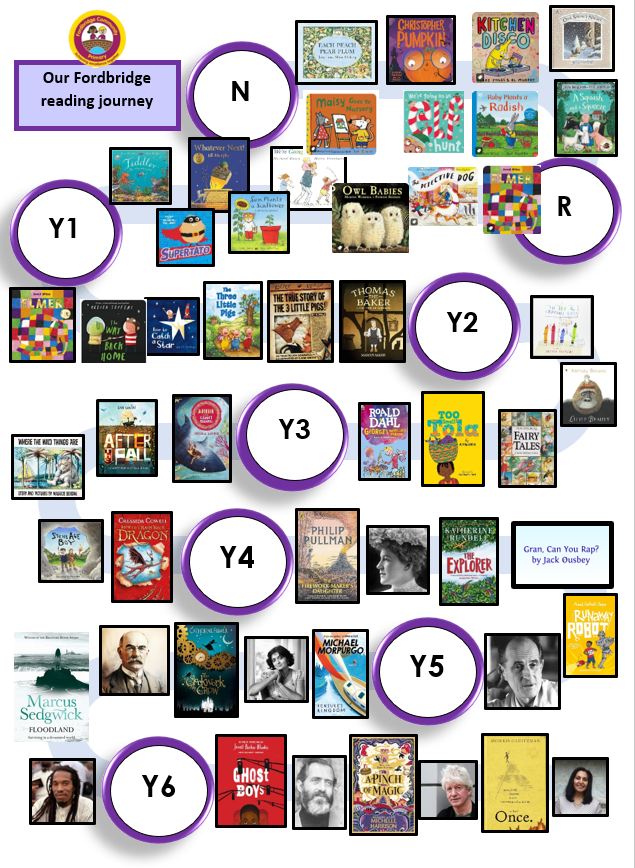
At least once a week, during a Book Talk session, classes enjoy Reading for Pleasure using texts that have been handpicked for each year group. This is a great opportunity for all children, regardless of their reading ability to develop a love of stories and hear reading being modelled to them. Each year group reading spine and Book Talk selections includes books that are diverse and promote different genres and text types.
Reading is also celebrated through regular visits to the school library, World Book Day, and providing each child with a book as a Christmas present.
Other enrichment activities include:
- Book Talk
- Parent Workshops
- Library visits/book shop trip
- School Council trips to select class reads
- A termly book fayre (including affordable books)
- Daily lunchtime book club
- After-school book club
- Virtual authors
- Careers Day – including authors/playwrites/film writers.
- Annual theatre trip using public transport (Y1-6)
- Reading events (World book day etc)
- Reading vending machine